Tuesday, March 11, 2014

Four Pillars of Trading Success from a Veteran Futures Trader

I had a long chat with an experienced futures trader that day. He shared with me his four pillars of trading success.

1. Ability to analyze and come out with own ideas.
You should have your own thinking, not to copy others trading ideas. I always stress the important of designing your own trading strategy, not blindly follow some experts' trading method or black box system. You need to understand your strategy inside out, know its characteristics, weakness etc. This is to ensure you are able to follow the strategy confidently when your trading are dealing with market adversity. At the same time, you will know when your system has stop performing statistically like it should in backtesting when market conditions change dramatically.

2. Money
Money here refers to adequate capital. To many, futures trading offer leverage, meaning you can start with very small capital and make huge profits. Many futures trader wannabe I met with started with as small as RM 10K and wished to make ten-fold profits in the shortest time possible. It is possible but the probability is very low. And to make such a huge profit, one need to take enormous risk and this increases the risk of ruin. Capital and risk management in futures trading is as important as cash flow management in a business. If a company faces negative cash flow problem, it might go bankrupt. If you can't manage your risk well in futures trading, your account are doomed to bust.

3. Patient
A good trade does not always start to make money immediately. Sometimes, price goes lower after you bought, causing you with unrealized loss on that particular trade. Panic and impatient trader will exit their position at loss, fearing the loss will widen. If a trade goes in your trade direction, impatient trader will take the profit because they want to lock in the profit and fear the market will take it away if they do not do so. Their behavior prevent profit to grow into huge one. Trend traders on the opposite, let the profit runs as big as possible. In the process, they may let a few unrealized profits turn into small losses. However they reckon this is inevitable and accept this as an expense of running their trend trading business.


4. Luck
Erm... Luck! Are you kidding? Take a look at the chart below.


Scenario 1-You quit your job and started your trend trading business in year 2005. You ended up with very tiny profits or small losses. You were forced to quit trading in early 2006 because profits were not enough to support your life.
Scenario 2-You quit your job and started your trend trading business in year 2006. You were rewarded with huge profits in your first year of trading. Then in 2007, you again made extraordinary profits. In 2008, you probably encountered volatile swings in your account equity earlier in the year, but you have plenty of "house" profits from 2006 and 2007 as buffer. At the end of 2008, you are glad that you didn't deviate from your trading system and were able to take advantage of market collapse to generate spectacular profits.

So, when is the best time to start trading full time? Unfortunately, no one knows when is the best year or so. I am lucky to have started my trading career full time in late 2008. So far, business is running rather smoothly. So, who say luck is not important in trading?

Friday, March 7, 2014

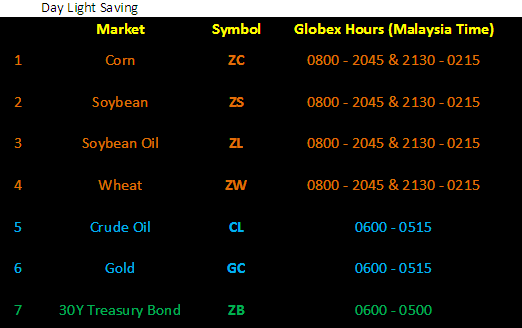
Globex Trading Hours During Daylight Saving

Daylight saving time 2014 will begin at 2AM on Sunday (09 Mar) in US. Most US states will spring forward an hour. Trading in CME Globex will bring forward an hour too.

Those who subscribe to FtR 9.7 Trading Signals Sharing, please don't forget to adjust your alarm clock 1 hour earlier.

Friday, February 28, 2014

FtR 9.7 Jan and Feb 2014 Signals Update


Not to say excellence but managed to grab some profits. Hope you guys also profit from my sharing.

Saturday, February 22, 2014

How to Jump on the Running Train (Trend)?


Apparently, FCPO is trending. I guess not everyone is enjoying the bull run because they missed the train. They chose to believe the breakout above 2700 is false. They were afraid to buy "high". They would rather miss the trend rather than risking their "sacred" capital. Whatever reasons it may be, if you are not on board of the bullish train, you may tempted to buy to participate in this "cpo bull of a lifetime". I received several requests and emails these few days, asked me how to get in the long side of the market. In this post, let me share some of my ideas for those who wants to buy but afraid the price is overly extended.

First thing you might need to ask yourself what is your objective of going to long this market? Of course a lot of people will probably say "money". I knew but you need to find out what kind of profits are you looking for in this long trade. If you are looking for 50-100 points quick profits, In my opinion, forget about it. You shouldn't be trading at all. For me, I will definitely want to participate in this rally to maximise the profits, meaning I will let the profits run as long as possible. In other words, I will only exit this long trade when market reverses and turns bearish (I will have my own method to determine when that happens).


Zoom in to 60 min chart to find trading opportunity. Retracement provides good and low risk entry into a developing trend. When price broke 2700, it didn't immediately shoot up uncontrollably. It retraced towards 2700, then moved up. This is a good place to initiate new long. One may wait till market completed the retracement by buying above the previous recorded high. In this example, buy above 2734. At the same time, set the initial stoploss below 2700. This involves risking about 40 points (RM1000) per lot.


The last time FCPO trading above 2700 was more than 12 months ago. This bull looks like still have a long way to go before it ends, therefore I suggest letting the profits run as far as it can. In this case, risking RM1000 per lot to achieve an unlimited profit target seems viable and logical. In case the long position got stopped out prematurely, I would definitely take any chance to re-establish long position again. Anyhow, if you look at 60min chart again, market broke the last resistance (2756) again last Friday.

Wednesday, January 29, 2014

恭贺新禧


马年到,新春闹,开开心心生活好;
祝福你,乐逍遥,马到成功喜气到;
扬鞭策马向前跑,年年岁岁吉星照;
马年福瑞长相伴,龙马精神得意笑。

Tuesday, January 14, 2014

Trading Signals Sharing

I am sharing with you guys my FtR 9.7 Trading Strategy signals.

FtR 9.7 is a swing trading strategy designed to capture "swing movement" in a particular futures market. It typically holds a trade for 1-5 days, depending on market situation. It generates about 5-15 trades per month. I will cover 7 futures products that trade in CME GLOBEX Platform. They are:-
1) Gold (GC)
2) Crude Oil (CL)
3) 30Y US Treasury Bond (ZB)
4) Corn (ZC)
5) Soybean Oil (ZL)
6) Soybean (ZS)
7) Wheat (ZW)

Each trading day, I will email subscribers the trading signals, which includes exact entry and exit orders before market open, that is 7:00 AM (Malaysia Time). The email reads like this:


Below are the trades done from Oct 2013 till early Jan 2014. Is shows the results of one contracts basis per signal generated. Commissions and fees are excluded in calculations.


Here is one trade signal from Soybean Futures (ZS) in Oct 2013.


If you are interested in subscribing to my trading signals sharing or have any questions, don't hesitate to email me at bmdtrader@gmail.com

Order Types and How to Use Them

I am writing this post to explain few types of orders we normally use in trading.


Market - This is the most basic and frequently used order type which tells the exchange's computers to execute your order at the next available price.  If you are buying your fill price will be the next available offer and if you are selling your fill will be the next available bid. To get a better indication of where you might be filled you need to look at the current bid/offer. For example, above is the bids/offers for Crude Oil June13. If you Buy Market 1 lot, you will get fill @ 92.98. If you Buy Market 10 lots, you will get 1 lot @ 92.98 and the remaining 9 lots @ 92.99. The difference between bid and offer is known as spread. In a liquid market like Crude Oil futures, the spread is small, in this case, 1 tick.  The advantage of using market order is that you will certainly get your fill in the fastest possible time. However the pitfall is that in a fast moving market, when liquidity is low, you might get very big slippage.


Limit - This is an order to buy or sell at a designated price. Normally we place a limit to buy is below the current market price, while a limit to sell is placed above the current market price.  For example, you place a Buy Limit Order for Crude Oil futures 10 lots @ 92.00 when market is trading higher (92.97 vs 92.98). All orders are filled on a First In First Out basis (FIFO); your order will be placed in the queue on the exchange’s computers.  Your order will only be filled after those orders in front of yours are executed.


Stop - Stop order are used as stoploss as well as entry for some traders. A Buy Stop Order is placed above the current market price and Sell Stop is placed below the current market price. Stop Order is a price order turn into Market Orders once the designated price trades. For example, we place a Buy Stop Order 10 lots Crude Oil futures @ 94.00, when market is currently trading @ 92.89 vs 92.90. When market trades @ 94.00, our Buy Stop 10 lots @ 94.00 will become Buy Market 10 lots. This means when market trades @ 94.00, we will buy 10 lots Crude Oil at next available offer price. Once triggered, our order will compete with other incoming Buy Market Orders; therefore doesn't guarantee our fill price same as the Buy Stop Price.  The difference between Stop Price and Fill Price is slippage.  

Order Cancels Order (OCO) - An OCO is actually two separate orders that are placed around a position, one of the orders is your Limit order to take a profit and the other is your Stop order to get out at a loss.  The advantage of this order is that once the profit or loss order is hit, the trading platform will cancel the remaining order for you. For example, you buy FCPO @ 2280 and place your Stoploss, a Sell Stop Order @ 2269 and Profit Target, a Sell Limit @ 2300. Once market trades either 2269 or 2300, the other order is automatically cancelled. However, I don’t think Bursa Malaysia Derivative or futures brokers in Malaysia offer this order in their services.  

Trailing Stop - A trailing stop allows you to enter a Stop loss order and have it move as the market moves in your favor based on your preset parameters.  This allows you to lock in a potential profit if the market moves in your favor.  Let say you short FCPO @ 2280, with stoploss @ 2300 and no profit target. When market moves lower to 2250, you can have your stop moved lower down to 2265. You may continue to lower your stops if market moves lower, ultimately when market reverse and take out your stops, you are out with reasonable profits. But don’t forget stops order doesn't guarantee you exit at your designated stop price. There might be slippage.

There are numerous more advance orders that are available in the marketplace but I don’t think they are available in our markets yet. So, I won’t cover here. Now, you know the type of orders. Try to incorporate these orders in your trading strategy and hopefully it helps you in your trading.